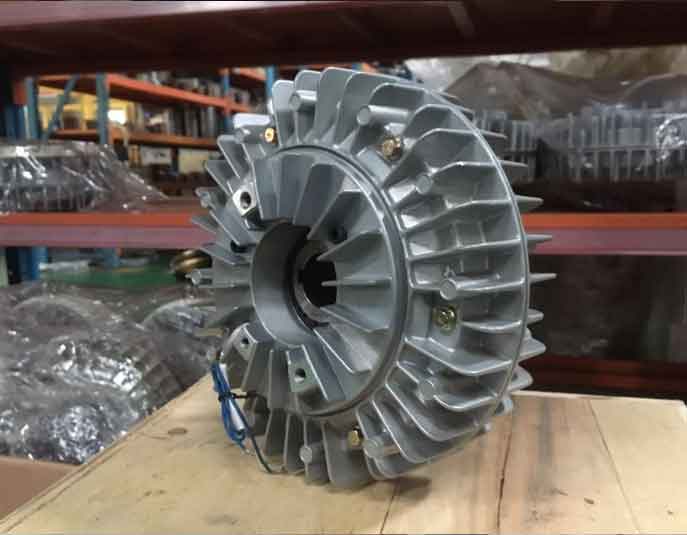
A magnetic particle brake is a typical automatic control component used in tension control, speed control, and torque regulation systems to achieve precise torque and speed adjustment.
As a common electromagnetic transmission device, it uses the magnetic resistance effect of magnetic particles to transmit and control torque.
Therefore, magnetic particle brakes see wide application in industrial production, packaging equipment, printing machinery, and textile machinery.
Working Principle of Magnetic Particle Brakes
Magnetic Particle Characteristics
Magnetic particles are special magnetic materials with unique reluctance properties.
When current flows through the coil, the particles form chain-like structures within the magnetic field, increasing friction and generating damping force.
Magnetic Particle Braking Principle
By adjusting electromagnetic field strength, the brake controls particle magnetization.
As a result, it regulates friction force and output torque, enabling precise braking and speed control.
Typical Application Fields of Magnetic Particle Brakes
Printing Machinery (Unwinding and Rewinding Tension Control)
- During printing operations, magnetic particle brakes control paper or film tension during unwinding and rewinding.
- They maintain stable tension, prevent wrinkles, misalignment, and material breakage, and improve print quality and productivity.
Packaging Machinery (Film and Paper Tension Control)
- Magnetic particle brakes widely serve unwinding and traction systems in packaging machines.
- They accurately regulate film and paper tension, ensuring smooth packaging processes and improving consistency and yield.
Paper Making and Paper Processing Equipment
- During slitting, rewinding, and coating, magnetic particle brakes achieve constant tension control.
- They help keep paper webs flat, reduce paper breaks, and enhance production continuity.
Textile Machinery (Yarn Tension Regulation)
- In spinning, weaving, and winding processes, magnetic particle brakes deliver continuous and stable tension control.
- They effectively prevent uneven tension, yarn breakage, and entanglement, ensuring consistent fabric quality.
Cable and Wire Production Equipment
- During wire drawing, wrapping, and winding, magnetic particle brakes precisely control wire tension.
- Stable tension helps maintain consistent wire diameter and improves product quality.
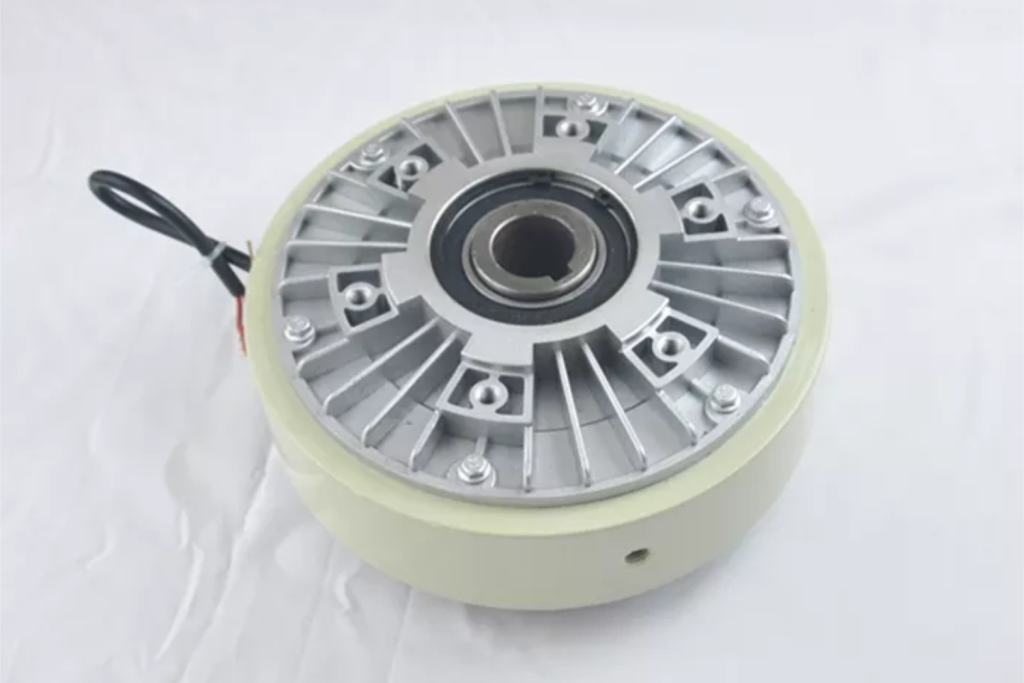
Application Considerations for Magnetic Particle Brakes
- Strict Thermal Management :During operation, magnetic particle brakes generate heat, so systems must ensure adequate natural or forced cooling.xcessive temperature reduces magnetic particle performance and shortens service life.
- Avoid Long-Term Overload Operation:Continuous operation beyond rated torque accelerates particle aging and may cause torque reduction or failure.
- Proper Operating Speed Selection:Magnetic particle brakes suit medium- and low-speed applications.For continuous high-speed operation, users should select enhanced cooling designs or alternative braking solutions.
- Excitation Power Stability:Fluctuating excitation current directly affects torque stability.Therefore, dedicated constant-current power supplies or tension controllers are strongly recommended.
- Protection Against Dust and Oil:Dust or oil entering the brake housing degrades particle condition and reduces control accuracy and service life.
- Preheating and Torque Calibration:For new installations or after long shutdowns, short low-load operation stabilizes particle distribution and restores torque consistency.
Conclusion
With high torque control accuracy, fast response, and smooth operation, magnetic particle brakes have become essential actuators in automatic control systems.
Through proper selection, effective cooling, and standardized operation, they deliver long-term stability and significantly enhance equipment performance.