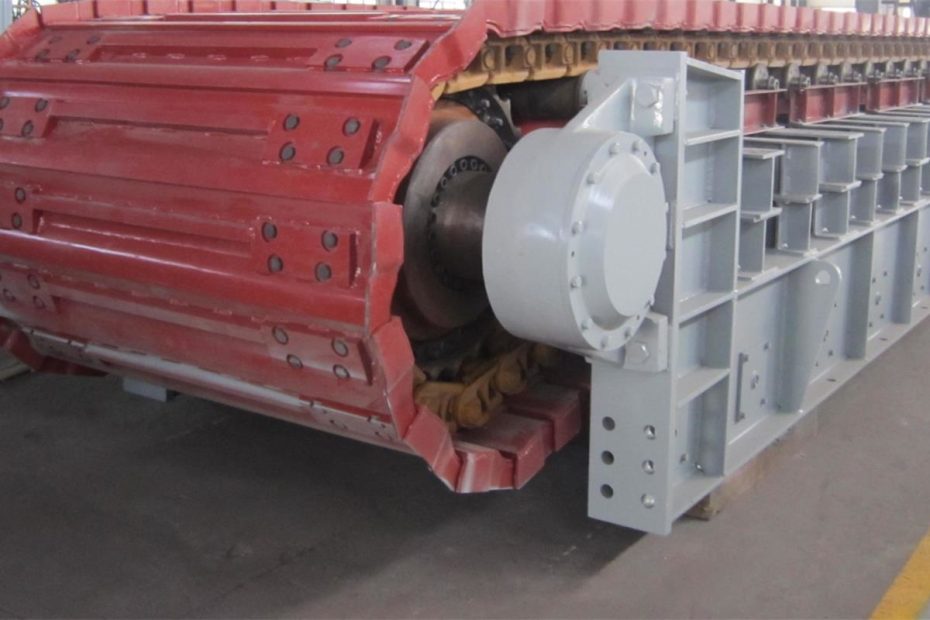
Apron feeders can be used to transport various block or loose materials from storage bins to crushers, conveyors or other working machinery in a horizontal or inclined direction. There are light, medium and heavy types.
Heavy-Duty Apron feeders are auxiliary equipment for transport machinery. In the crushing and grading workshop of large ore dressing plants and cement, building materials and other departments, they are used as silos to continuously and evenly feed materials to primary crushers. They can also be used to transport materials with large particle size and specific gravity over short distances.
Heavy-Duty apron feeders can be installed horizontally or tilted. In order to avoid direct impact of materials on the feeder, the silo must not be unloaded.
Heavy-Duty apron feeders are flexible in layout, can be driven left or right, can transport materials horizontally or tilted. Its tilt angle is 0 ≤ a ≤ 25°. Users can select according to the actual site.
Introduction to Vibrating Feeders
In addition to apron feeders, vibrating feeders are another widely used type of feeding equipment in the mining, metallurgy, building materials, chemical, and food industries. A vibrating feeder uses vibration generated by an exciter or vibrating motor to make the material slide or throw along the feeding trough, thereby transporting the material from the storage bin to the receiving equipment in a continuous and uniform manner.
Compared with apron feeders, vibrating feeders have a relatively simple structure, light weight, and low power consumption, and they are especially suitable for feeding fine, granular, or small-to-medium block materials. Common types include the electromagnetic vibrating feeder, the electric-motor vibrating feeder, and the reciprocating-plate vibrating feeder, which can be selected according to the material characteristics and process requirements.
The main advantages of vibrating feeders are as follows:
- The feeding amount can be conveniently adjusted by changing the amplitude or frequency, enabling stepless speed regulation.
- The structure is compact and sealed, which helps reduce dust spillage and improves the working environment.
- It can realize automatic control and centralized management, and can be linked with crushers, screens, and conveyors to form an automated production line.
- It has good adaptability to materials and can feed both dry and slightly humid fine-grained materials.
It should be noted, however, that vibrating feeders are generally not suitable for feeding very large, heavy, or sharp-edged bulk materials over long distances; in such cases, a heavy-duty apron feeder is usually the more appropriate choice. In practical engineering applications, the two types of feeders are often used in combination — the apron feeder handling the primary coarse feeding at the front end, and the vibrating feeder performing precise, quantitative feeding in the subsequent process — so as to give full play to their respective advantages and improve the overall efficiency of the production system.
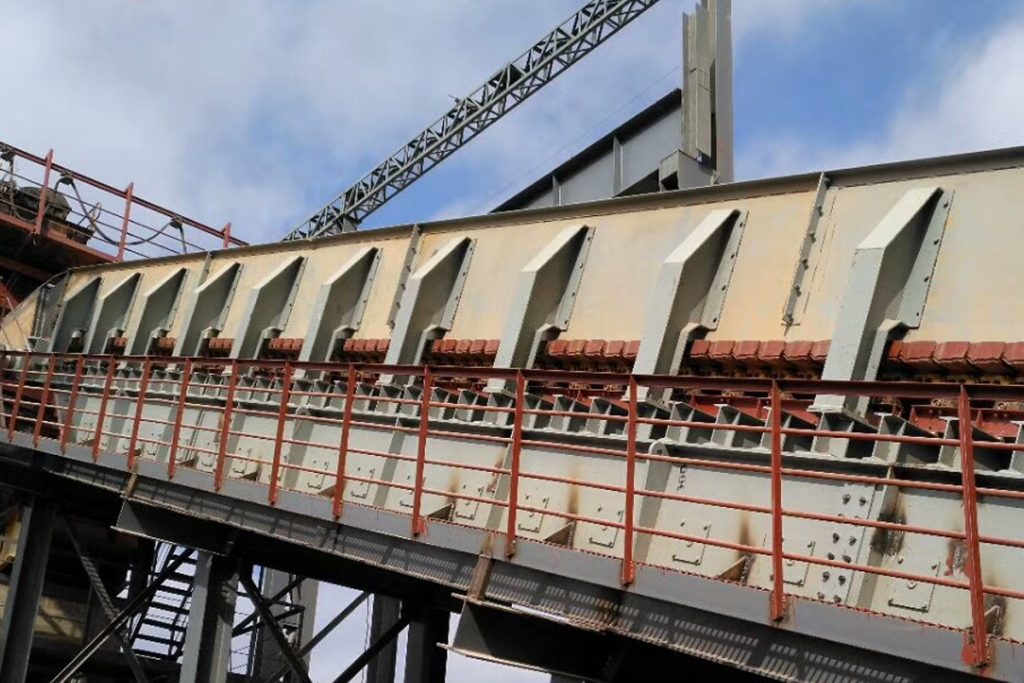
Structural Advantages Of Heavy-Duty Apron Feeder
Heavy-Duty apron feeder complete machine and spare parts: head wheel device, tail wheel device, chain plate (groove plate), chain, upper drag chain roller, load-bearing roller, return roller, chain, etc.
- The chain adopts the crawler chain used for bulldozers, which has high strength, safe and reliable operation, easy to use, and no oiling of chain links is required, and it can be transported for a long distance.
- The chain apron has high bending strength and impact resistance. The chain apron uses lap-jointed welded chain plates, which do not leak materials or deviate during use and have good wear resistance. In addition to the support of the supporting wheel, the chain belt is also equipped with a slide rail support.
- The chain belt tensioning device is equipped with a buffer spring, which can reduce the impact load of the chain and extend the service life of the chain.
- The drive device is suspended on the main shaft of the machine and is not connected to the foundation, so it is easy to install and disassemble, and has the advantage that the meshing performance of the reducer gear is not affected by the foundation accuracy.
- The drive adopts a large-ratio orthogonal reducer, eliminating the open gear drive mechanism, reducing the lateral size of the machine and facilitating process layout. The allowable installation angle is large, up to 25°. It can make the selected equipment small in size, the process layout reasonable, and save investment.
- The electronic control device can automatically adjust the feeding speed of the feeder according to the load of the crusher, so that the crusher receives the material uniformly, the working load is stable, and the system can be automated.
Conclusion
The heavy-duty apron feeder runs smoothly and reliably with low noise. It is widely used in mining, metallurgy, cement and other industries. It is an indispensable equipment in raw material processing or continuous production, and is particularly suitable for running large and sharp materials. Together with vibrating feeders and other auxiliary feeding devices, it forms a complete material-handling solution that meets the diverse needs of modern industrial production.